This blog has been archived, no further content will be uploaded or added. You are welcome to continue viewing posts, however commenting has been disabled.
Wednesday, December 9, 2020
What Christmas Means to me
Thursday, December 3, 2020
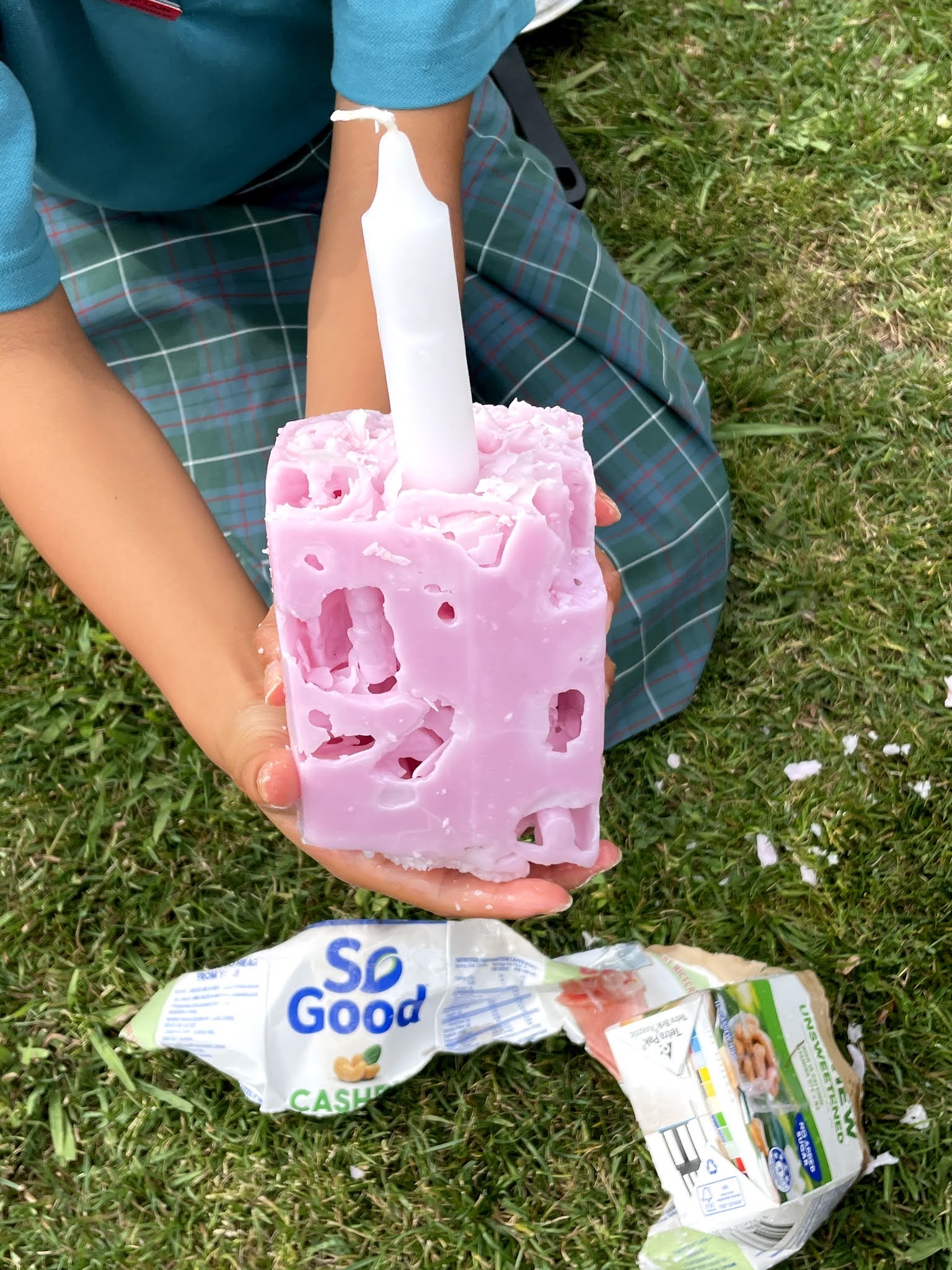
Ice Candles
Friday, November 6, 2020
Camp Thank you Letter #2
Thursday, November 5, 2020
Thank You Camp Letter
We are writing thank you letters to the people who made this camp possible.
I chose Shaun, our group adult and Francesca's dad.
He did belaying for the Rock climbing and high ropes. Belaying, is the person who moves the rope when you are in a harness high up.
Rock climbing was my favourite, and though I was really scared that I would fall, I knew I wouldn't hurt myself. It took a lot upper and lower body strength.
Catalina C
40 Campion Rd
Gisborne
5 November 2020
Dear Shaun,
I am writing to you to thank you for your help and work to make the Year 5 and 6 camp possible, just like every single adult that helped. This camp was one of my favourite memories out of my time at St Mary’s School. You looked out for everyone, including our group (Fran, Ciara, Selina, Elena, Jorja, and I), our buddy Group (Jason, Corin, Noe, Arcangela, Mikaela, and Unaise), and even people who weren’t in our group. It wouldn’t be the same without you!
I enjoyed the rock climbing the most out of the Tui Ridge activities. You were the best at belaying! Thank you so much for encouraging me to go further even though I really didn’t want to. Flying fox was hilarious when you zoomed down.
So thank you Shaun, for taking your time to do this, look after us, and help the teachers cope with all of us 69 kids, which they probably couldn’t keep an eye on for 4 days all on their own! I hope you keep the St Mary’s Year 5 and 6 camp in your memories.
THANK YOU!
Ngā mihi
Catalina
Friday, October 16, 2020
A Letter to the Editor
There is a newspaper column in the Gisborne Herald where people can get their say.
We wrote about how the council isn't responding when we ask them to do their part and mow and spray the bushes at our rerenga awa so we can plant more native trees.
I found it tricky to start it.
I found it easy to give reasons why the should help us.
Here is my letter:
Dear Editor,
I am a student at St Mary’s Catholic Primary School. Our School is a Green Gold Enviro School so we plant New Zealand’s native trees in our Rerenga Awa, River Garden. Rerenga means garden and awa means river. We want to encourage native birds and insects, freshwater creatures, and create a clean, clear river. But the blackberry bushes are stopping us from planting more. We can’t have a clean river or freshwater creatures because we can’t plant any more trees, and can’t provide shade. It is the council’s job to spray and mow those bushes. We have been to see the council, emailed them, and used their app, but we haven’t got a response. Surely, the council can do their part of looking after the environment.
Yours sincerely,
Catalina, Room 1 st Mary's
Thursday, October 15, 2020
Brownie Batter
This week for writing we are learning how to use imagery using similes, alliteration, and juicy verbs.
Our cameo was an excerpt from "Joey Pigza Swallowed the key" by Jake Gantos.
I found it easy to use juicy verbs.
I found it tricky to use alliteration.
Sucking and licking the orange rubber spatula, my mouth watered and shook as the full oozing of sugar and chocolate took over my flavourless mouth. Blissful brownie batter slid down my throat like a wet paint slithering down a wall. I savoured every single drop. I scraped the bowl with my finger because that spatula just can't reach the rest. What were fingers made for? I shielded my bowl from my desperate siblings. I looked back at the bowl wondering why it was now so sparkling clean. Then my eyes widened. I was ready to cartwheel 100 times.
Thursday, September 24, 2020
Catalina's Room 1 September Student Reflection Newsletter
I found it easy to fill it in since I've done it a lot.
I found it tricky to explain Maara Kai.
If you want to learn about biosecurity click here.
Thursday, September 10, 2020
Why you should be Vaccinated
Friday, August 28, 2020
Animals should not be kept in Zoos
WALT use persuasive and emotive language.
Tuesday, August 18, 2020
The Moa
Listen to my reflection here.
The Moa’s classification is the Dinornis Robustus/ novaezelandiae.
Description
Moa’s may have looked like an emus, judging by its skeleton. Their feet have three toes face forwards and one facing back. Female giant moa were larger than the males and were probably over 2 metres tall (taller than you!) and heavier than 250 kilograms (definitely heavier!) Moa had poor eyesight, good sense of smell and a short beak.
Habitat
Moa lived in New Zealand and the Stewart Islands. Little Bush Moa and Mantell’s moa lived in thick forest, while the crested and upland moa lived in the mountain zones of the South Island.
Diet
From the analysis of their fossils it suggests that they ate shrubs, trees, herbs, and grass.
Each of the six types of moa had different shaped beaks, indicating they adapted to different plants.
Threats (were)
Maori substantially hunted Moa for food. Moa bones were carved into fish hooks, and pendants. The skin and feathers were made into cloaks and clothing. There have been a number of claimed historic sightings of the bird, but none had critical observations. Now, the moa are extinct.
Catalina
10/08/20
x
Thursday, July 30, 2020
Toroa (Southern Royal Albatross) Fact File
I chose the Toroa (Southern Royal Albatross) because I went to Dunedin I went to a Albatross sighting place.
I found it hard to make the fact file from scratch.
I found it easy to find an Albatross picture.
Wednesday, July 22, 2020
Report Writing
We got a Level 3 Lion Report and cut to bits (literally).
We tried to put them back in the right order, with paragraphs, sticking to one topic per paragraph.
Then we used our pink highlighter to highlight the spelling mistakes.
Their success criteria was to:
- Adjectives, for description
- Subject specific vocab, words relating to the topic
I found it easy to highlight the mistakes.
Wednesday, June 24, 2020
Matariki
For writing we are learning about Matariki.
I found it hard to write about the nine stars.
I found it easy to write about what happens and Matariki.
I tried to use subheadings.
What is Matariki?
Matariki is the Maori name for the 9 sisters and cluster of stars that appear during June and July. It was a time for family, food, games, and haka. Our ancestors used it to predict the weather- if it was hard to see the stars separately it meant that they would not have much harvest. However, if the stars were easily seen by the naked eye, it meant the crops would flourish and they would have lots of food.
Maori use the Maori calendar, not the European calendar, so the dates for Matariki change every year.
The Matariki Legends
Other parts of the world see Matariki, but they see a different perspective. The Japanese see 5 stars and call it “Subaru.” In Greece they call it “Pleiades.” In the Maori culture Matariki is the Mother of the 8 daughters, also part of the nine stars.
The Nine Stars of Matariki
What is Matariki?
The Matariki Legends
The Nine Stars of Matariki
Matariki is the star that represents reflection, hope, and the gathering of people. She is also part of the health of people.
Pohutukawa is the star connected to the ones that have passed away.
Wati, the twin of Waita is the star connected to fresh water, as in, rivers, lakes, and also the animals that live in them.
Twin of Wati, Waita is the star connected with the ocean and the seafood within it.
Waipuna-a-rangi is connected to the rain.
Tupuanuku is connected with everything that grows in the earth and is harvested.
Tupuarangi is connected with things that grow in the trees, like manu (birds) and berries.
Ururangi is the star associated with the wind.
Hiwa-i-te-rangi is the star connected with granting our wishes.
Thursday, June 18, 2020
Ahmet's Journey Comic Strip
I found it hard to find pictures of Syrian boys.
I found it easy to do the actual comic strip because I read a lot of graphic novels.
My digital learning object shows I can insert a slide and use shapes and pictures.
Next time I would try to make it more detailed.
Thursday, June 11, 2020
Gravity
We are learning about gravity in writing.
Here is my explanation.
Imagine you tripped up and your lunchbox flies out of your hand. What happens to it?
The lunchbox falls down. Why? The lunchbox fell down because of gravity. Gravity is a force that pulls us back down to earth, unlike space. For example, pretend you have a slinky attached to your shoes. It allows you to jump up! But… eventually fall back down.
Gravity is a natural force that keeps us on the ground instead of floating off into space. A force pushes or pulls when it acts against an object. It can cause an object to move or change direction.
Gravity is like invisible super glue that keeps us all on earth. You can’t see it, but it’s always there.
There once was a man called Isaac Newton.
He was the first person to really study gravity.
You might’ve heard this story when Sir Isaac Newton was sitting under an apple tree and an apple fell and hit him on the head. Boink! He wondered, why doesn’t the apple float up, or fall sideways? That’s when he made up the three laws of Newton.
The first law was that an object will stay there unless an unbalanced force acts upon it. The second law is force equals mass equals acceleration, meaning the more force, there’s more mass, which is the object of matter, equals more speed. The 3rd law of motion is for every action there is an opposite reaction, like if you push a chair, it will move, which is the reaction.
Squash a boink down and will bounce up. The more pressure you put on it the higher it will bounce but also, fall back down because of the cause of gravity.
If you invert a dropper popper, it will activate it. Dome-down, with a ping pong ball, it will fly into the air when it hits ground, it will revert and launch the ping pong ball. It will go in the air but gravity will still take hold of it and fall back down.
What happens when you throw a ball up, sideways, or down? The answer is the same. It will still stay in the air for a while, but then, once again, go back down.
So, no matter where you throw a ball, its going down. Gravity is cause and effect. It will cause objects on earth to stay on the ground, like us!. You will get an opposite reaction, which is Newton’s 3rd law of motion. An object comes back down on earth, no matter what.
Friday, June 5, 2020
Homophones
Homophones are words that are pronounced the same but have different spelling and meaning.
There, T-H-E-R-E, means over there, that place. They’re, means they are. You use an apostrophe for this, drop the A and it becomes they’re, they are. Their means it is their things, their stuff. Another example of homophones is whole and hole. Whole is the entire object. Hole means like a ditch, or a trench. Our last example is allowed and aloud. Aloud, A-L-O-U-D means saying something out loud. Allowed means that you have permission to do something.
Wednesday, May 27, 2020
Splash Slide
- use juicy verbs
- different sentence starters
- simile
Thursday, May 14, 2020
The Choco Cake Caper
Thursday, April 30, 2020
My Lockdown Diary Pg 19-20
- Morning, wakey, wakey! What's the plan this morning?
- What are you looking forward to after lockdown?
I found it easy to think of the things I miss.